You were sent for an angiogram, and the report came back with words nobody explains properly: heavily calcified, diffuse disease, not a good candidate for bypass. And then the conversation seems to stop there.
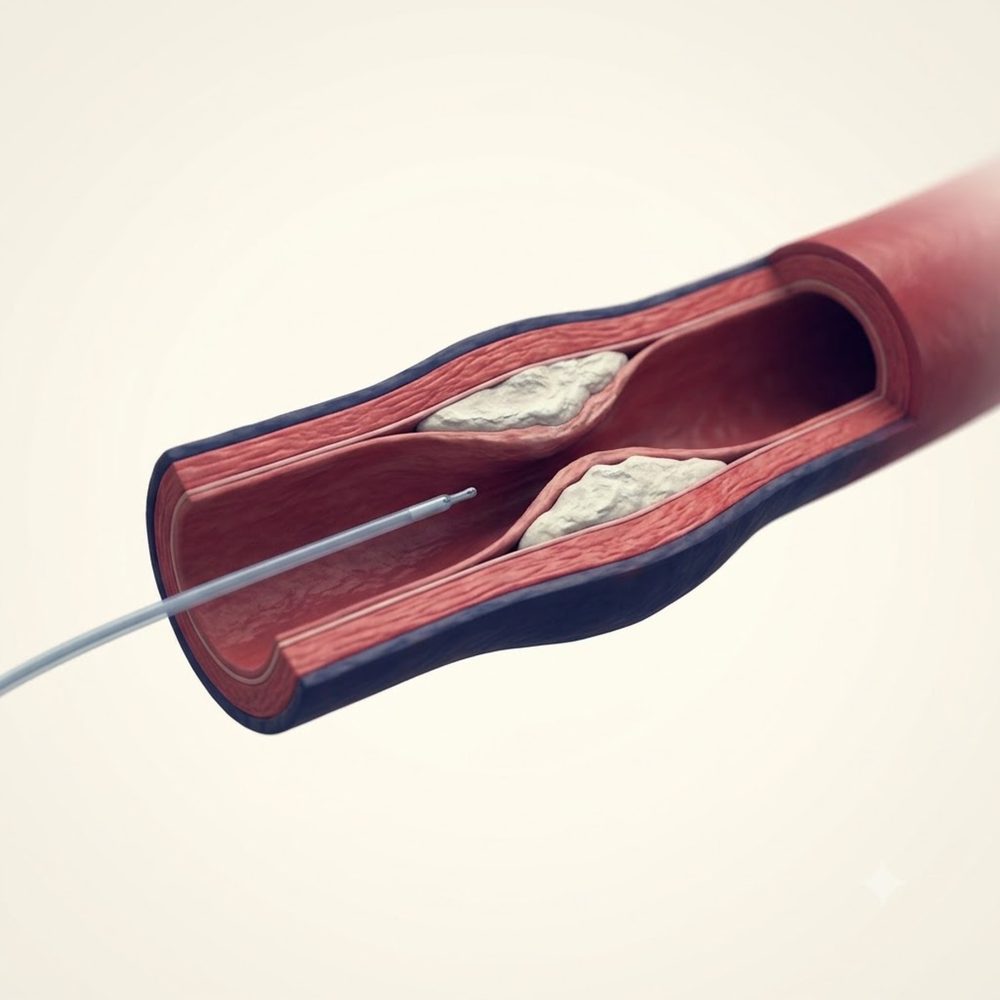
It shouldn't. A blockage that has turned hard and chalky is a difficult problem — not automatically a closed door.
What "calcified" actually means
Over years, cholesterol deposits inside an artery wall do not stay soft. Calcium settles into them, the way scale builds inside an old water pipe. The artery becomes rigid and narrow, and two things follow:
- A plain balloon may not open it. The wall simply refuses to stretch, or springs back the moment the balloon comes down.
- A stent may not expand fully. An under-expanded stent is the single biggest reason a stent gives trouble later, so no cardiologist should accept one.
This is why a calcified artery is not "just another angioplasty". It needs the calcium dealt with before the stent goes in.
Why some people are told bypass is not suitable
Bypass surgery remains the right answer for many patients with multiple blockages. But it is sometimes advised against — for example when the arteries beyond the blockage are too small or too diseased to attach a graft to, when the lungs or kidneys make open surgery high-risk, when a previous bypass has already been done, or when overall frailty makes recovery from surgery difficult.
Being told "surgery is not advisable for you" answers only one question. The next question — what else is possible? — deserves its own discussion.
What can be done for hard, calcified blocks today
Modern coronary work has specific tools for calcium, and they are chosen based on what the calcium looks like on imaging from inside the artery itself (IVUS or OCT), not guesswork:
- Rotational, orbital or laser atherectomy — the hardened deposit is carefully sanded or vaporised to create a channel.
- Intravascular lithotripsy — sound-pressure pulses crack the calcium ring from inside, much like lithotripsy for a kidney stone, leaving the softer tissue alone.
- Cutting and scoring balloons — these score the rigid plaque so it can yield evenly instead of tearing.
- Stentless Angioplasty with DCB — in selected segments, treatment without leaving another layer of metal behind.
- Circulatory support (IABP or Impella) — used when the heart muscle is weak and needs support while the work is done.
These are not alternatives to a careful decision. They are what makes a careful decision possible.
What a second opinion should include
If you are carrying an angiogram CD and a one-line verdict, bring both. A useful review looks at the actual images rather than the summary, considers the strength of your heart muscle, your kidney function and your diabetes control, and then tells you plainly which of three paths fits you: medicines alone, angioplasty with calcium modification, or surgery. Sometimes the honest answer is still surgery, or still medicines. You are entitled to know why.
When to get it looked at sooner rather than later
- Chest tightness or breathlessness that now appears at a shorter distance than last month
- Discomfort that has started waking you at night or appearing at rest
- An angiogram report from the past year that you never had explained to you